Exploring The Cultural Taste Buds Of Nigeria

Kekefia | Image: Ivanka Catering Service
“Good food is very often, even most often, simple food.”
― Anthony Bourdain
The soul to our culture is tucked in between spices and the delicacy of the local kitchen. These Traditional cuisines, like many oral traditions, have been passed from one generation to another with food practices often memorised and hardly documented. The recipe of the people is a reflection of their history. The enormously populated Nigeria is extravagantly multicultural, and in this diversity lies a unique aspect-food!
Let’s dive into the rare culinary of some Nigeria cultures; our lives could just be a combination of magic and good food.
Ekpalana
From the urban street of Yenogoa to the hidden creeks of Oloibiri where
oil was discovered first, there is a food that unites the Ijaw people of
Bayelsa. Ekpalana! An upgrade of Kekefia (another popular southern
dish) is used for special occasions. Plantain in whatever form is
useful; ripe, unripe, or overripe, plantain would always serve the right
purpose with its endless culinary expressions.
First, you chop unripe plantain into tiny bits or cubes, put it on fire to boil with just enough water. Next, you cut off a whole plantain leaf and pass it over the fire to slightly wilt slowly. This creates a coat on the leaf, that way it doesn’t tear off easily. Add some fish or meat or snail already garnished with grounded crayfish and Uziza seed, spices and placed inside the plantain leaves. This is wrapped up and tied carefully with palm fronds. Once done, you cook in a pot along with your plantain till soft. This process gives the plantain porridge a distinct flavour. The liquid paste produced from the porridge is then separated as soup that will be eaten along with the porridge and some palm oil.
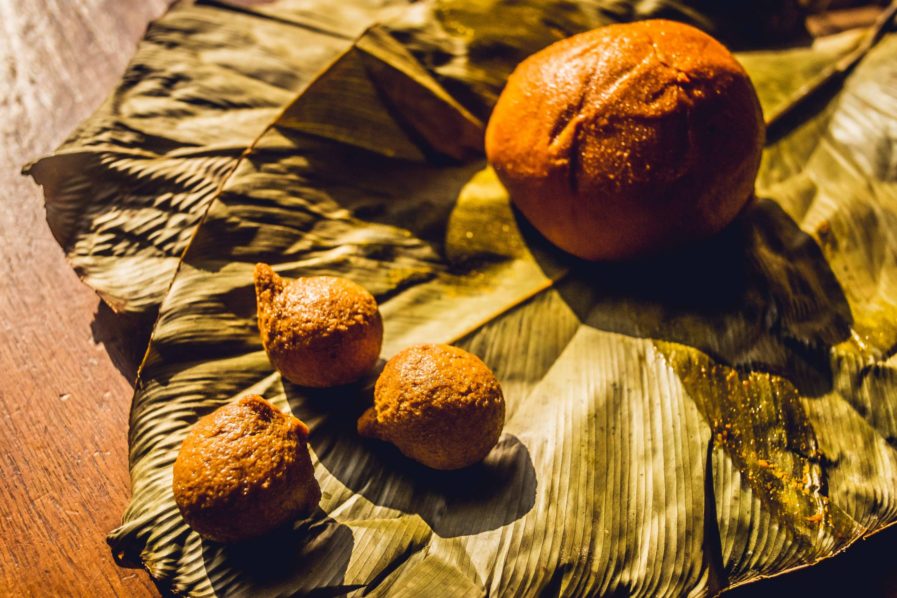
Aadun | Image: Pinterest
Adun or Aadun
Adun is a very simple snack among the Okun people of Kogi state, a group
of Yoruba dialect-speaking communities in North-central Nigeria. Unlike
the typical peppered corn meal familiar with the Yoruba people, also
called Adun, the Okun people have a unique way of making theirs. You
roast the cornmeal to brown and grind it into powder form adding
grounded pepper, then you fry the beans separately till it foams of oil,
after which you mix with your cornmeal and wrap into banana leaves.
Adun can last up to a year when stored properly.
Aniga
An ancient food of the Oko people of Anambra, Aniga is prepared from
water yam and cocoyam. The water yam and cocoyam are peeled with every
single piece grated into a mortal and stirred hard using a pestle
thoroughly. Wash and squeeze bitter leaves (Onugbu) with salt then add
to the yam and cocoyam paste. Leaves from plantain are cut and exposed
to mild fire for it to wilt. Each portion of the paste is carefully
spread on the leaves and wrapped with stems of palm fronds. Place each
wrap into a pot and allowing it to boil for a long time until it is soft
for consumption. The final process is making the sauce, which is a mix
of red oil, African nutmeg, spice and hot water. Pour the sauce into the
cooked food and allow to simmer for consumption.
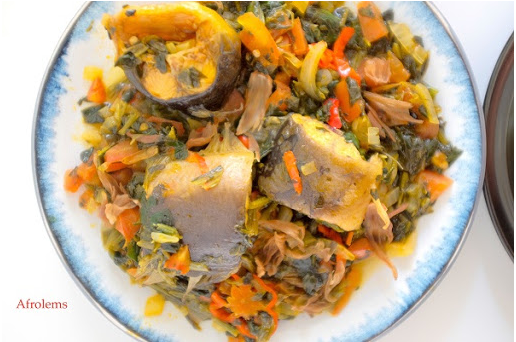
Margi Special Soup | Image: Afrolems
Margi Special
The Margi people are located along the Mandara Mountains in Adamawa and
spread towards Cameroon and Chad. The indigenous Margi special is a
typical food if you travel far northeast, Nigeria. Zobo leaves (dried
Roselle plant flowers) are soaked in hot water and left overnight to
ferment. Slice your catfish together with tomatoes, peppers, green
vegetables and onions into a bowl. Seasoned to your taste, boil in the
zobo water as you gradually add oil and leave it to cook till it is
done. The fish sauce goes well together with Tuwo Shinkafa.

Sapala | Image: Kitchen Butterfly
Sapala
What happens when you replace the beans in Moin-Moin with corn? You get
Sapala. This is a typical Ijebu food that is easily made from fresh
corn. Stock the cobs to get your sweet corn, then with a combination of
ingredients such as chilly pepper, sliced onions, crayfish and salt to
taste, you grind in a blender till you have your creamy corn. Scoop it
with a spoon into a wrap which can be Moin-Moin leaves, tins, or
aluminium foils and cook till it gets done.
S’agba Rigidi
This translate to “make the elderly strong”. This is a “heavy” diet
which once you’re done eating, you only crave for water and more water.
This is prepared by the riverine Awori people of Lagos. Unlike the way
Eba (garri) is made with hot water, S’agba rigidi is prepared with the
water used in boiling crabs. After making the Eba, onions, salt and
chilly pepper are added and stirred together. The crab’s shell is
opened, and the morsels of Eba are dipped into it.


Comments
Post a Comment